Japanese Blue Note Pressings, Explained
When we wrote up the story of Blue Note, we left Japanese pressings for later. There was simply too much to say. Dig through Blue Note records for long enough and you keep running into copies marked "Japan." And you hear story after story of LP collectors flying to Tokyo and coming back with armfuls of records. So why Japan, of all places?
Blue Note lands in Japan
It started with the sale of Blue Note. As we covered in the Blue Note post, Alfred Lion sold the label to Liberty Records in the mid-1960s. And the company releasing Liberty's records in Japan happened to be Toshiba's record company. Toshiba was already handling Liberty's catalog in Japan, so when Liberty bought Blue Note, Toshiba took on Blue Note too. It was the first time a company in Japan officially handled Blue Note.
Before that, Blue Note was something you could only find in Japan as an expensive import from the US. Toshiba didn't press records in Japan right away, either. Around 1966 it officially brought in Blue Note records pressed in America and sold them wrapped in a Japanese obi. The obi is a paper strip wrapped vertically around one side of the jacket, with the album title and a short introduction in Japanese.
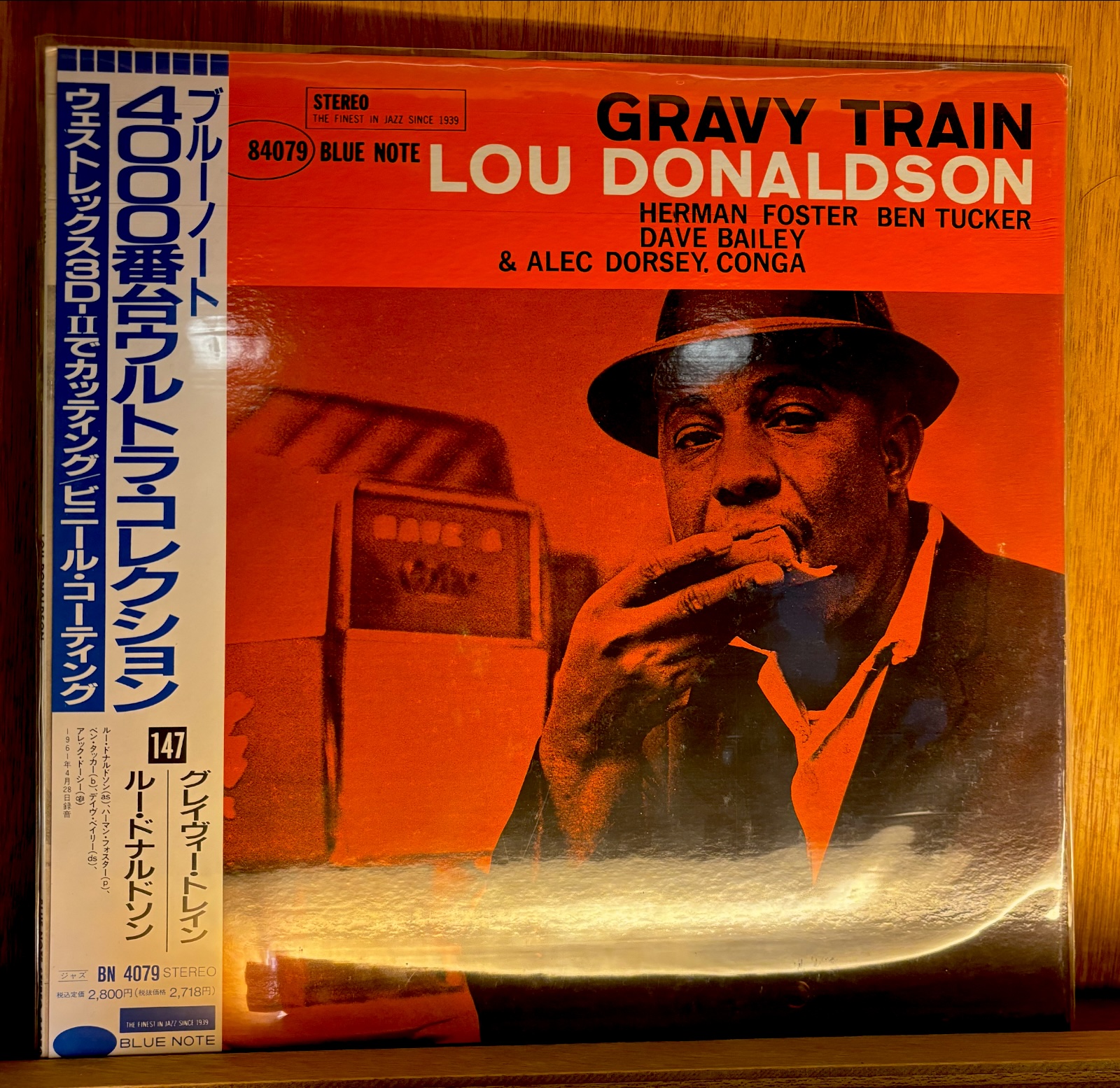
Then, from the late 1960s, records began to be pressed in Japan itself, and the history of the Japanese Blue Note pressing truly began.
The country that loved jazz more than America
The truth is, jazz had long been a minority music in America too. Once the dance-hall swing era faded in the 1940s and jazz became music for listening after bebop, the public's attention moved on to R&B and rock and roll. Even in the country where it was born, jazz became music that only those in the know sought out.
In Japan, though, jazz was the sound of a new world that had crossed the ocean after the war. And people in Japan listened to it seriously, studied it and collected it. A country that listened more seriously than the one where jazz was born: that is why we call Japan the country that loved jazz more than America.
Jazz kissa
Blue Note could settle in so well in Japan because people there were already seeking out jazz. At the center of it all was the jazz kissa, a coffee shop that played jazz records. In the days when records and audio gear were too expensive for most people to own, the price of a cup of coffee let you hear the latest jazz records on a great sound system. At their peak there were said to be hundreds of them across Japan.
A jazz kissa was more than a coffee shop. Some even banned conversation so that everyone could focus on the music, and a culture of listening to jazz as serious art grew up in these rooms. Haruki Murakami ran a jazz kissa himself before he became a novelist, and DUG in Shinjuku, which appears in his novel Norwegian Wood, welcomed jazz fans for more than 60 years before it sadly closed in the summer of 2026. As this culture of listening properly took root, Japan became one of the countries that loves jazz most seriously.
That love is still part of everyday life. Travel around Japan and, exaggerating only a little, you'll hear jazz playing in curry shops, udon shops, even convenience stores.
The jazz kissa culture is now spreading beyond Japan. Under the name "listening bar," places that play records on a good sound system and put the music first have opened in cities around the world, and in Korea, too, more and more places are following the jazz kissa way. (Static shares something with them in taking jazz seriously, but we are not a jazz kissa.)
The country that brought Levi's back to life
Why Levi's, all of a sudden? Because no story explains better how Japan took in American culture.
Japan's love of jazz isn't only about jazz. After the war, with the US military stationed in Japan, American culture arrived all at once: jazz, along with jeans, movies and fashion. It was a time when jazz played in the clubs on US bases and the Levi's American soldiers wore found their way into Japanese markets.
What's interesting is that the Japanese didn't stop at copying it. They loved old Levi's so much that they dug into every detail, from the thread and the fabric to the dye and the stitching, and brought them back exactly as they were. Japanese jeans made that way are now sought after by America and the rest of the world. This movement is sometimes called "Ametora," short for "American traditional."
Jazz and Blue Note were no different. Japan pressed the records again just as they had looked, kept old records with great care, and rediscovered players America had forgotten. A country that cherished and protected American culture more seriously than America itself: that is Japan.
The hard bop boom
There was a clear moment when Japan fell for Blue Note in particular. In 1961, Art Blakey & The Jazz Messengers, Blue Note's flagship band, came to Japan. Fans crowded the airport with bouquets, and the band members later recalled that they had never been treated like that in America. Musicians who were a minority act at home were stars in Japan.
After that tour, a hard bop boom swept the country, and Blue Note was right at the center of it. This was before Blue Note had even officially arrived in Japan.
The country that brought Sonny Clark's shelved albums into the world
Japan's love of Sonny Clark is famous. The pianist, who died young, had long been a forgotten name in America, and it was Japan that rediscovered him. Some of his recordings that had been sitting in Blue Note's vaults were first released as albums in Japan, too: My Conception and Blues in the Night, put out by King Records, which we'll come to shortly. Thanks to them, collectors in America and Europe started listening to him again.
In Japan, Cool Struttin' is said to have sold several times more than it did in America, and even more than Blue Train. That gives you a sense of how much Japan loves Sonny Clark.
How Japan kept Blue Note going
From the late 1960s, Blue Note in America was fading. After Alfred Lion stepped away in 1967, the label lost much of its old energy, and in the 1970s jazz itself was losing ground to rock and dance music.
In Japan, though, Blue Note's popularity didn't cool down at all. It grew. By the late 1970s people were saying that Japan was practically holding up the jazz record market on its own. Blue Note, which Toshiba had taken on in the 1960s through its ties with Liberty, had become a label every Japanese record company wanted.
With that many buyers, the pressing runs were unusual too. Japanese record companies pressed Blue Note records in large numbers to keep up with demand, repressed the classics every few years, and sometimes reissued whole series at once, like the 1500 series. Records that had become hard to find in America could be picked up without much trouble at a neighborhood record shop in Japan.
The Japanese companies that handled Blue Note
A quick aside on licensing. To press and sell an American label's records in Japan, a company needs a license, in other words official permission. So why didn't American labels just sell their own records there? Shipping heavy LPs across the ocean costs a lot of money and time, and import taxes push the price up further. A Japanese company pressing locally could sell for less, and could also take care of getting records into Japanese shops and adding Japanese liner notes and an obi. The label collected license fees, so it was a good deal for both sides.
Japan wasn't the only country where Blue Note licensed its records. Local companies also pressed Blue Note in the UK, France, Germany, the Netherlands, Canada and elsewhere. But no other country pressed so many, for so long.
The rights to release Blue Note in Japan moved every time the label changed owners in America, and each time, the Japanese company handling Blue Note changed too.
| Period | Japanese company | Background | Pressings from this period |
|---|---|---|---|
| 1966–1977 | Toshiba (later Toshiba-EMI) | Toshiba, Liberty's Japanese partner, took on Blue Note too | The first Blue Note records pressed in Japan |
| 1977–1983 | King Records | United Artists, Blue Note's owner, signed with King | Classic reissues plus the first releases of unissued recordings |
| 1983–2013 | Toshiba-EMI (later EMI Music Japan) | When EMI took over Blue Note, it returned to EMI's Japanese company | Large-scale reissues, including the entire 1500 series, and limited series around 1990 |
| 2013 onward | Universal Music Japan | Universal bought EMI | High-quality reissues continue |
Toshiba's record company later teamed up with Britain's EMI and became Toshiba-EMI. So when EMI became Blue Note's owner in 1979, Blue Note came back to Toshiba-EMI a few years later. An old connection, picked up again.
Things are very different now. With Blue Note and its Japanese record company both part of the Universal family, the old way of licensing an outside company to press records in Japan is a thing of the past. Series like Classic Vinyl and Tone Poet, which we covered in the Blue Note post, are pressed in one go at plants in the US and Europe and shipped around the world, and in Japan they are often released with an obi and Japanese liner notes added. So the records that were actually pressed in Japan in years past are all the more special.
King Records' six years
From 1977 to 1983, the Japanese rights to Blue Note briefly passed to King Records, after United Artists, then Blue Note's owner, signed a deal with King. It was a short stretch of just over six years, but you can't talk about Japanese Blue Note pressings without the King era.
Something remarkable happened during these years. Unissued recordings that had been sitting in Blue Note's vaults were released in Japan first. Blue Note records that hadn't come out even in America could be heard in Japan before anywhere else.
King gathered these unissued recordings into a series billed as world premieres, releasing more than 20 titles between 1979 and 1980. Albums by players still loved today, like Sonny Clark, Grant Green, Kenny Burrell and Hank Mobley, first came into the world this way, in Japan. Here are just some of the best known.

| Artist | Album | Japanese release |
|---|---|---|
| Sonny Clark | My Conception | 1979 |
| Sonny Clark | Blues in the Night | 1979 |
| Grant Green | Matador | 1979 |
| Kenny Burrell | K. B. Blues | 1979 |
| Art Blakey | Pisces | 1979 |
| Jackie McLean | Tippin' the Scales | 1979 |
| Hank Mobley | Poppin' | 1980 |
| Curtis Fuller | Two Bones | 1980 |
| Lou Donaldson | Sweet Slumber | 1980 |
| Tina Brooks | Minor Move | 1980 |
Most of these albums were recorded by Rudy Van Gelder in the 1950s and 60s. Those analog tapes crossed the ocean, were mastered by Japanese engineers, and were pressed onto LP for the first time in a Japanese plant. As we said in the Blue Note post, an original is the copy pressed when an album is first released. So for these albums, the Japanese pressing is the original first pressing.
By bringing recordings that had been asleep in the vaults into the world for the first time, King Records wrote a new chapter in Blue Note's history.
Their sound is well regarded too. Collectors often say King-era pressings hold their own against the American Liberty pressings, and many collectors look for King pressings in particular among Japanese pressings. Toshiba-EMI pressings, from after the rights went back, get mixed reviews depending on the period and the series.
Perhaps that's why King pressings tend to fetch higher prices than Toshiba pressings on the used market. Of course, this is collectors' experience, so in the end you have to listen for yourself and decide. For the record, we at Static like King reissues much more than Toshiba reissues, too.
Reading Japanese catalog numbers
With a new series every time the company changed, Blue Note records pressed in Japan alone come in quite a few branches. That's one reason collecting Japanese pressings became a world of its own.
Just as BLP and BST numbers told you the era of an American pressing in the Blue Note post, the letters in front of a Japanese catalog number tell you roughly which company pressed it, and when.
| Prefix | Company | Approx. period | Notes |
|---|---|---|---|
| NR | Toshiba | 1969–1971 | The first Blue Note LPs pressed in Japan |
| LNJ | Toshiba-EMI | 1976–1977 | Toshiba-EMI's last series before the move to King |
| GXF | King | 1977–1980 | Limited editions, including the world-premiere series of unissued recordings |
| GXK | King | 1977–1981 | King's main reissue series |
| K18P | King | 1982–1983 | King's last series before the rights moved on |
| BLP | Toshiba-EMI | 1983–1984 | The 1500 series repressed under the original American numbers |
| BNJ | Toshiba-EMI | 1983–1986 | 4000 series reissues and more |
| BN | Toshiba-EMI | 1989–1990s | Limited and pre-order series such as the "Last Reissue" |
BLP in particular is easy to confuse, because the numbers match the American originals exactly. Check the jacket and label for Japanese text or a Toshiba-EMI credit and you can tell them apart.
While America was on a break
As we said in the Blue Note post, after EMI took over Blue Note in 1979, new albums all but stopped in America, and the label didn't reopen until 1985. Yet through those very years, King and Toshiba-EMI in Japan kept pressing Blue Note records without a break, from the old classics to unissued recordings that had been asleep in the vaults.
While Blue Note caught its breath in America, Japan's jazz boom kept it alive. If there were fans waiting when Blue Note got back on its feet, that may have been partly thanks to Japan.
Why Japanese pressings are loved
How they differ from American pressings
As we mentioned, the sheer number of Japanese pressings sets them apart. So even for the same Blue Note album, an old American pressing and a Japanese pressing are quite different propositions.
| Old American pressing | Japanese pressing | |
|---|---|---|
| Condition | Many are worn and damaged after decades | Many have been kept clean |
| Supply | Few copies left | Pressed in large numbers, easier to find |
| Price | Expensive. In great condition, the sky's the limit | Relatively cheaper than American pressings |
So if you want to hear Blue Note on a copy in good condition but an original is too much of a stretch, a Japanese pressing is the most realistic choice. If condition is all that matters, why not just buy a new reissue? Honestly, the reissues coming out lately don't quite satisfy us. There's a reason people say that with Blue Note, the older the pressing, the better.
Japanese pressings are often described as quiet and clean, with no surface noise. The jacket usually comes with Japanese liner notes and an obi, too. Of course, popular Japanese pressings, like King pressings or copies with the obi still intact, can get quite pricey.
That said, a quiet, clean sound isn't necessarily the sound jazz fans love. Plenty of people say that for a thick, rough sound that hits you head on, American pressings are still better. (Which is why everyone ends up hunting for American pressings again.)
That is why so many buyers hop over to nearby Japan and come back with armfuls of Blue Note.
The obi: pros and cons
You can't talk about Japanese pressings without the obi. Japanese owners tend to take good care of their records and jackets, so even used copies often still have their obi, and whether the obi is intact can make or break the price.
The obi has its pros and cons, though. It certainly adds to a record's value, but it also covers part of the jacket artwork. So when Static brings in a Japanese pressing, we carefully slide off the obi and keep it separately. A Blue Note jacket is a work of art in itself.
Where people still buy records in record shops
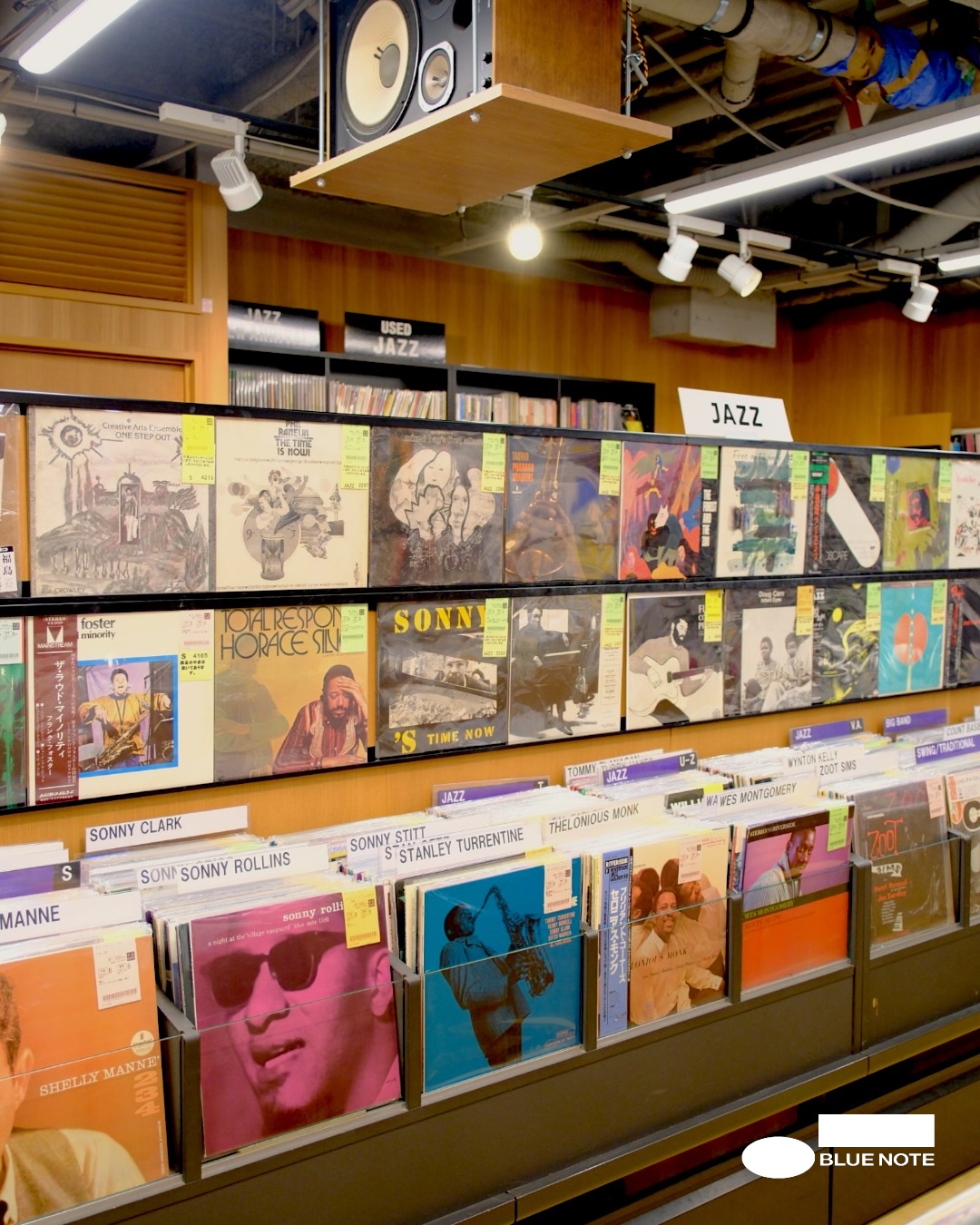
Tokyo still has plenty of record shops like Disk Union, where you flip through the bins by hand. Above all, there are a lot of used records. Records that Japanese buyers bought and cared for over decades come back to the shops, and the racks are packed with Japanese pressings. For a collector, it's nothing short of a treasure trove. The numbers say the same. Japan is the world's second-largest music market after the US, and even now that streaming dominates, roughly half its revenue comes from physical formats like CDs and LPs. Counting physical sales alone, it is the largest market in the world. It's a country where buying records you can hold in your hands is still alive.
As LPs have surged back in popularity, Japan's record market has drawn even more attention worldwide. Used record sellers from many countries gather in Japan to buy in bulk, and Japanese pressings with their obi scatter across the world. Music that crossed over from America became records in Japan, and is now being exported back out to the world. Funny, isn't it?
Closing
Maybe Japan really did love jazz more than America. Jazz was born in America, but the place that cherished its records most, and kept them best, was Japan.
Japanese pressings have also played a big part in the culture of collecting Blue Note. American originals are scarce and keep getting pricier, so without Japanese pressings, collecting Blue Note might long ago have become a game for a small circle of collectors. Thanks to Japanese pressings, plenty of people can still own Blue Note records in good condition, and those just starting out can share in the fun too.
Japan is also where the shops that play real records for people to listen to, the forerunners of today's record bars and listening bars, took shape, and it is still something like heaven for record collectors. We're not saying that out of favoritism; collectors all over the world say the same.
That's why so many collectors still head to Tokyo's record shops today. For record collectors in Korea, having the world's largest physical music market just a two-hour flight away might be a blessing.
That makes two long posts about Blue Note. We set out to explain how to read labels and catalog numbers, and somewhere along the way it became the story of a label that crossed an ocean and survived. Our shelves at Static hold Japanese pressings too, their obi set aside. When a Blue Note record is playing at the bar, you might find yourself wondering where that copy came from.
That brings our long story of Blue Note to a close. Thank you for reading all the way to the end.
Long live Blue Note!